Tag Archives: personal development

Always Make Time for Self-Reward

Have you ever had one of those days that you felt sucked into the vortex of negativity? Like you can’t do anything right? Or like Murphy’s Law is beating you down? Then this is the Vlog for you. Dr. Natalie shares with us one of her own personal experiences of feeling she is being taken in by this and helps learn how to pivot into a new direction.


Don’t know if the Learn To Love Your Story could help you. Then take this quiz and see which Online Courses would best help you with your personal growth and development.

What Course Is Right For You?

So many of us get stuck at some point during our lives.  We know that we are not fully happy, yet we don't really know what's missing.  We just know that we thought it would feel better than this by now. So what gives?

Dr. Natalie's online courses are designed to help you build the skills you need not only to find out what seems to be missing in your life and keeping you stuck; her courses will help you liberate yourself from your past and starting designing the LIFE YOU HAVE ALWAYS WANTED.  

Take this quiz and receive an individualized recommendation from Dr. Natalie as to what course would be best for you and why these courses are specially designed to help you with what you need.

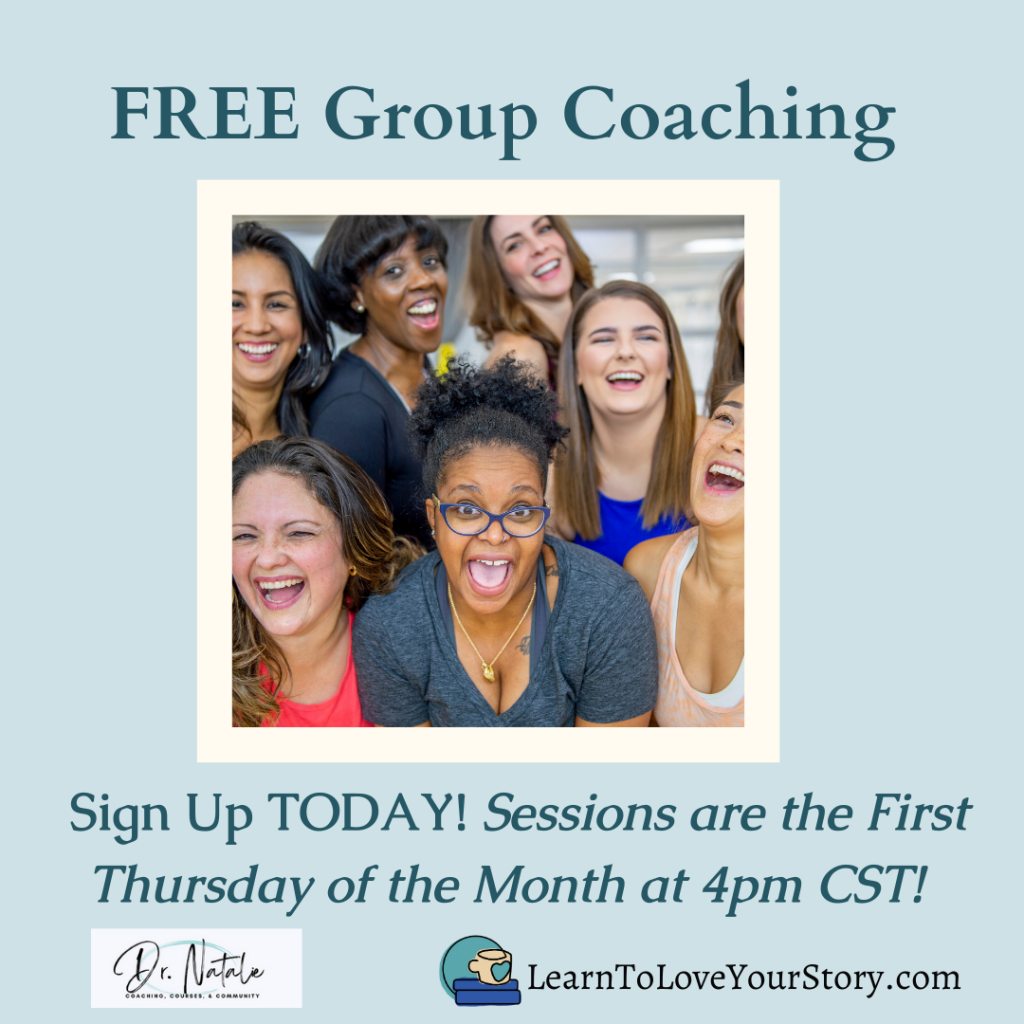
FREE Group Coaching For a Year – Join ANYTIME!

Join us monthly as we work together to help you design the life you have always wanted for yourself. No gimmicks! Just results! Dr. Natalie has nearly two decades of experience as a Clinical Psychologist and she is ready to help women in midlife break the chains of living in constant survival mode.

Please be sure to sign up. Even if you can’t join every month, you will also have access to online courses, workbooks, guided meditations, and get the video highlights sent out after each months group coaching event. It is well worth it!!! Make 2023 your year!!!


How To Work With Dr. Natalie


Do I Get to Want Things?


Mumblings of a Midlife Mess

Are you a woman in midlife who feels complacent in a life you don’t feel excited about anymore? What if I told you that I could help you rediscover JOY in your life and help you to DESIGN A LIFE that you’ve only dreamed about? I assure you I can.  Don’t think this can be true?  Ask me your questions and I will show you how midlife can be your BEST LIFE!

check out my:

© 2022 Learn To Love Your Story.
All Rights Reserved.

One of the main reasons women in midlife come to my programs is to find a sense of self again.  I know that sounds strange, yet the truth is these women have no idea who they really are or what they really want in life.  They know what they do, they know who they care for, and they may even know what they are good at. What they don’t know is who they really are.  The real version of them.  The one that has been locked away inside.  Why is this?  Because early in our childhood the social conditioning begins.  “Be a nice girl” we are told.  “Shouldn’t you share that with your friend?” we are asked. We are even likely to hear, “you’re a natural at being a little mom for everyone” or “You are so good at knowing what others need.”

And then we are off to the races.  Once we are conditioned to find our worth in how we codependently take care of others, we are hooked.  Like a drug, we seek more and more and more.  We want to be that friend, that sibling, that spouse, that parent, who against all understanding can hold it all together.  Can take care of all the things and still look good doing it.  Because don’t forget our looks are our other form of social currency as women.  It has to look easy and we must look beautiful doing it, in order to fully gain our worth. And we hustle for our worth in this madness for a long while.  Many of us keep hustling, until we can’t anymore. And when the last of our roles has ended and our beauty’s shiny luster wears off with age, where does that leave us?  It leaves us to our own devices.  It leaves us with ourselves.  Only the woman who we now inhabit has been a human doer for so long, she is a stranger to us.  Who is she at all?  What are her wants and desires?  We sometimes have no idea where to even start.

That is usually where I come in.  A woman will come into my office for therapy or join one of my programs for coaching and we will start to unravel the layers of social conditioning that has told her who she is.  We are seeking to help her find who she actually is.  Underneath all the tasks she had and roles she played is an actual person. However, it is a person that often times has been so horribly neglected for years there is no recognizable aspect to this person. This self (inside the socially conditioned woman/human doer) is a stranger to the women who work with me.  This is where the work begins.

Learning to Love Our Stories is a journey of self love, self exploration, and self empowerment.  Yet not one of those things is attainable without true self awareness.  If we do not know the person we truly are we cannot love them, we cannot help them explore, and we certainly cannot help them make empowered choices to create the life they want to live.  And that is where all stories begin really…they start with meeting the main character.  So what happens when you are the main character and you don’t know yourself? Answer…you start to know yourself by listening.  You are listening for what it is you truly want.  That is usually a wonderful indication of who you really are.

So here is the catch.  If a woman has been conditioned most of her life to look out in her world and identify what is wanted of her by others and meet those needs, she has atrophied the cognitive muscles to look inside and see what she wants and needs for herself.  And when these women are finally sitting with me trying to learn these new skills it is an effortful process.  It is like an adult trying to pick up a new language.  Let me explain. Speaking fluently in a new language is never going to happen overnight.  There will need to be repetition.  Tons and tons of repetition.  And even then we initially learn a new language by translating it through our native tongue.  So you hear a phrase in the foreign language and you think through the lens of your current language to know what that means.  Then you decide in your current language what you want to say back and you translate that back into the foreign language.  It takes a LONG time to really get the hang of this. A LONG TIME and A LOT OF PRACTICE.

So how does this match up with what women are trying to do when they are learning to know the real version of themselves?  Let me give you an example.  Once I helped a mother at the start of her empty nesting, who was really struggling to know what she wanted in her life.  She had spent the better part of nearly three decades taking care of her kids and her spouse, making sure that their every need was met.  So now as she was looking at retirement from those roles she was really shook up.  She didn’t have a purpose.  She didn’t see a meaning to her existence any longer.  Her depression was entrenched in this understanding that she had worth as a mother and a wife, yet the circumstances of her life were no longer providing her opportunity to express this worth.  This was her native tongue.  To be a human giver in a family setting.

Here is where the new language starts.  We talked at length about self care…a totally foreign concept and one that was saturated with this idea that she was selfish if she did anything for herself.  She wanted to start being better about self care, but she wasn’t quite sure how to do that when it always felt so uncomfortable.  I would suggest starting with easy things that she already wants.  She then asked me, “Do I get to want things?” She was seeing the idea of self care (the new language) through the translation of her old life, which told her doing something for yourself is selfish and childish. What happens is the ideas are lost in the translation.  “Doing for yourself” or “self care” has different cultural meanings when translated literally. In the language of a therapist it is a form of general hygiene, like brushing your teeth every day, eating nutritious meals, and getting enough sleep.  In my client’s language, “doing for yourself” meant she was choosing herself above others and in so doing disrespecting those she loved.

Any good teacher knows that when there is a meaning breakdown, it is helpful to bring in a metaphor that makes sense to someone given their cultural conditioning.  So one of the ways I helped this woman to see what self care meant, was by translating it through the idea of caring for others.  She needed to see herself as one of the “others” she was caring for in her life.  For years, her spouse and children had wanted for nothing as she had dutifully served them.  Now she needed to turn her attention to the one that was neglected all that time…herself.  This was still uncomfortable for her, so we took the metaphor a bit further.  I asked her what she would think if her youngest child came home and told her that they had felt ignored their whole lives in the family home.  That all the other siblings had more needs than this child did, so this child learned to be quiet and not make a fuss.  And if this child told my client that they had watched as she poured herself into the other siblings and now this child was feeling neglected and somehow jilted as a result of this inequity, I asked my client, “What would you do for this child?”  My client had a TON of answers for that and a reinvigorated purpose as she spoke about what she could do for this child in a scenario like this.  When she was done telling me what she would do for that child, I told her to think of herself as this neglected child and to apply those same ideas to herself.  That is the true meaning of the translating the meaning of self care into her native language.

Women often have no idea that they don’t know themselves and almost never have a language for this experience.  What they know is they are sad, irritable, aimless in their purpose and function in life, complacent, and not sure where to start to try and fix any of this.  I tell them that they are right where they need to start.  In their discomfort.  As I teach them a new language for how to know themselves and articulate their needs and wants, I ask that they sit in their discomfort and listen.  Listen to what the discomfort tells you.  If you are worried whether you did enough for your children, maybe what you are hearing is that not enough was done for you.  You can’t literally translate what you hear into your native tongue.  Your body mind doesn’t speak that way.  If you hear yourself filled with resentment that your partner has an entire life with their work, hobbies and friends, maybe what your body mind is telling you is that you want a life too and its urging you to go out and find that.  If you notice yourself feeling lonely, maybe what you’re hearing is that you need to expand your tribe and find new connections.  Piece by piece, thought by thought, worry by worry, I help these women translate what their body minds are telling them and help them to create new self empowered choices to design a life the meets these new insights.

What can be really neat about my work is that it is a lot like a treasure hunt.  There are treasures hidden under the sea of emotions that we are having as we transition in midlife.  Our job is to learn the movements of the sea and the storms, in order to understand where those treasures may have drifted off to on the seafloor.  It is always an adventure.  And it is not for the faint of heart.  We must prepare ourselves for storms as we set sail to find ourselves.  Treasure is there to be sure, but so are dangers.  A trusty navigator and a crew are always helpful additions to this journey.  If you think you are in this boat on your own, take a listen to what a recent group cohort said about their journeys in the Learn to Love Your Story program.  You may find that having someone like myself on your side, who has the navigational tools to manage the sea and storms, as well as a group of women that are in this with you to discover their own treasures, is just the right fit for what you need to weather your midlife storm.

It’s Lonely at the Bottom


Mumblings of a Midlife Mess

check out my:

© 2022 Learn To Love Your Story.
All Rights Reserved.

I know we are all very different in our experiences in life, yet there are some very universal aspects to our lived experiences that I think we overlook.  We think that we are “all alone” in our experience, when in fact we are not alone.  In fact, we may all of been there in one capacity or another. So today’s blog is really about helping us to explore this concept and maybe save ourselves from the collective illusion that we are alone in our suffering.

When I was in my thirties, I found myself in a management position on a large scale for the first time.  I had supervised and managed prior to this, but during this particular stint in my career I found myself in boardrooms with individuals (mostly male and mostly white), whom had been doing these jobs for decades.  I was definitely the lowest on the totem pole as far as seniority and gender role, and most definitely was seen as green.  This lead me into a continual battle of trying to prove my worth in this environment.  I was working harder and longer hours than anyone else in this level of management and getting less recognition than all of them.  It came to a head for me towards the end of my work with this agency, when I joined a coalition within the agency that was looking at making some modifications across disciplines and the CEO of one of those disciplinary areas took credit for not just part, but all of what I did.  ALL OF IT.  I am certain that my name never even came up in the rooms where this man pitched these ideas.  He later was promoted and then found employment outside the agency entirely, and you better bet that this interdisciplinary project was part of the wave he was riding as he did so.

This was a major learning moment for me.  I had the fortune of also working under a manager that was a woman, who had experienced many similar instances in her longer career with this organization.  We commiserated some about this, yet that wasn’t enough to satisfy me.  I was really upset by the feeling that there was a setup that I wasn’t going to be able to break working within this kind of a hierarchy.  It was one of the factors that lead to my looking for other employment and moving on in my career.  What I discovered is that once you are in the unenviable position of hustling for your worth and proving yourself, that energy takes over completely.  Its lonely at the bottom.  And if you don’t stop this pattern yourself there is no one else that will come to save you.  You have to be your own hero.  Others will always benefit from your assuming the myth that your worthiness must be proven.  Others can (and many unfortunately will) capitalize on your courageous efforts to prove yourself by taking credit for your work, your credibility, and your value.  Not everyone is trying to do this as an intentional and manipulative ploy.  It is just that the system of “haves” and “have nots” will always result in more “haves” and “have nots”.  If you assume the role of a “have not”, trying to always prove yourself to the “haves”, then you are perpetually within that energy.

This is not to say you can’t liberate yourself from this.  You can, but you must remember that you will not liberate yourself within the context of this system.  You will have to leave the system behind completely.  Sometimes this happens in the literal sense, as it did for me when I left this position; and sometimes it is in a more figurative sense, when we leave behind the unspoken rules of “haves” and “have nots”, and dance to a different drummer right within the context we are stuck in.  I’ve tried it both ways…and in both contexts I have learned another valuable lesson.  It is always lonely at the bottom.  Meaning…when we get started with a venture like this, we feel like we are on our own.  We are fighting the fight, yet we are depleting our own stored energy because we have no back up.

I want to explore this part of the journey a little further.  I see this “loneliness” factor as a rumble strip (for more explanation on what I mean by this, feel free to read another blog where I explain this metaphor in more detail). Loneliness tells us that we are slipping back into the “have” and “have not” paradigm again.  We feel alone, because we are still indoctrinated in the illusion that we are fighting to prove our worth.  When you notice that you have a case of the “I’m all alone in this”, stop.  Here is where you need to change your tactics.  The truth REALLY IS that we are NEVER ALONE.  NEVER!  In fact there is always people suffering in these same ways we are. We are not unique in these experiences.

In fact, the illusion that we are alone is a function of the “have/have not” system of oppression. Except, instead of others oppressing us, we are doing the work for them. This feature of how systems sustain inequalities is called internalized oppression. The things we were taught and learned we are now enforcing on ourselves.  In this case, believing we are alone in this suffering keeps us locked in the energy of trying to prove ourselves over and over again.  There is nothing to prove.  We already have worth.  Yet, if we keep trying to prove that worth, there is an implicit bias that we may not have that worth in the first place or we wouldn’t have to prove ourselves.  As we continue to pursue proving ourselves we are keeping ourselves oppressed on autopilot, without anyone else having to do anything.

The remedy to this is to get connected to others.  To build ourselves a community of people that let us know this is not the case.  In the story I’ve shared here, my community started with someone else who had the same experience and was willing to help me see I was not alone.  This connection started to build a community of other supporters in my career that were there when I felt stuck in the spiral of “have” and “have not”, and would challenge me to break the the cycle by not participating in my own suffering.  I would stop trying to prove myself and would honor my worth.  If those who I worked with didn’t honor that worth too, I would leave.  They did not deserve my service if they could not honor the worth it brought to their organization.  Ultimately that has lead to my working for myself.  I said NO liberally. Said NO without abandon in these organizations when they were not honoring what I brought to the table. And eventually I said NO as many times as I needed and disappointed as many people as I needed, so as NEVER to disappoint myself again.

That is, until I realized I had become both my “have” and my “have not”.  I had started to hustle for my worth in my worth again, even though I was working for myself.  I wanted to prove myself to myself, that I could have my own practice and start a new business venture simultaneously.  And when the math didn’t work, because there were not enough hours in the day, I doubled down and kept killing myself trying to make both work.  I was going to prove it to myself that this could be done.  But then I realized that insidious “have” and “have not” system had seeped into me again.  I was feeling alone in my battle.  I was noticing that I wasn’t feeling appreciated.  I recognized that even without another person to prove myself to, I could get caught in the grips of proving myself and hustling for my worth.  As I noted in my first blog in the “Mumblings of a Midlife Mess” series, I was going back to an old and familiar pattern and oppressing myself without even noticing.

The antidote…community.  And you, my story lovers, are a part of that for me.  I need to surround myself in the truth that I already have the worth and no hustling is necessary.  I don’t need to prove that the side hustle can out-do the day job.  It already has that worth.  I just have to have faith in that truth and act accordingly.  So, I share this with you to help you see that even we can be our own oppressors.  Even with the best of intentions, we can fall into old patterns.  And one of the ways that we can stop this in its tracks, is to share it with others.  To out it.  To say aloud, this system is not serving me and is not true.

I am not lonely at the bottom, fighting for my worth.  I am in good company all around.  We have all done this to ourselves and we will all continue to fall into these old patterns. Yet, if we come together and gain the support of one another when we recognize this, we can and will transcend this.

How to Map Out a Better Life

Have you ever tried to get somewhere without using your GPS or a map? How’d you do? Probably not well. Most of the time we are all pretty good about looking at the map, using the GPS, reading the instructions, etc. But when it comes to our lives, we mostly are just winging it or following the path set for us by society, family, religion, or culture. It is very infrequent that we seek out professional help from a coach or clinician, unless we have gotten stuck and need a boost. Dr. Natalie suggests that we access help sooner, almost like we are consulting with a map maker to help us set up the map to a better life. Take a look and see what you think of this idea.

How to Increase Your Joy by How You Tell Your Story

Did you know that the way that you tell your story to yourself and others greatly impacts how you see the world? Many of us don’t think of it this way, however Dr. Natalie helps us in this video to understand how the two are linked. She goes on to help us understand how to catch ourselves when we are telling a story that is creating or accentuating our suffering. She helps us to see that by changing our story we can change the outcome of our perceived enjoyment of our lives.

How to Boost Inspiration

Are you a women in midlife that feels like the life transition you are in has you falling flat and feeling less inspired? Dr. Natalie talks in today’s Vlog about how this is a normal stage in any major life transition and what causes this to occur. She also shares with us a tip on how to reconnect our inspiration with our goals in action. Take a look.


Come to our monthly Master Class for FREE, in an intimate coffee and conversation setting. This is a great place to get some FREE Group Coaching from Dr. Natalie, helping you be the best version of yourself all the time. Please be sure to sign up. Even if you can’t join every month, you will be part of the mailing list to hear about the topics and get the video highlights sent out afterwards, so it is well worth it.

Or, if you are looking for something a little more in depth, take a look at the Online Courses to help your with your personal growth and development.

Advice For “Adulting” Well

We do this funny thing in our culture. We have set an arbitrary age as the age when one becomes an adult. And it’s not in our 30s or even in our 20s. This is the age of 18. And how ridiculous is it that we find ourselves telling 18 year old humans that they are adults?

Today my son turns 18. He’s my firstborn and the one that so lovingly allowed for me to become a mother. Not unlike many other women that I know, becoming a mother was really the becoming of me in general. Something about being responsible for another human as they grow, really creates space for us to become aware of ourself. My experience has been no different. I learned who I was in the process of helping this human make it to 18 years of age.

We are not at 18 years old ready for this world. I promise you that many of us aren’t even ready for this world when we hit our 40s, 50s, or even 60s. I have done enough hours of therapy with clients across the couch to know that this arbitrary idea that there is an “age of adulthood” is one that messes with us. We have the sense that we “should” know better, however we only end up “shoulding” on ourselves. And by the time we have contorted ourselves so many times that we are feeling anxious and depressed and show up in the office of a therapist, we have really caused ourselves some damage.

So here is a bit of advice that I have gained over the course of the last 18 years as I have parented my children and more importantly come to discover my own adult self. It isn’t earth shattering, and it isn’t even stuff that you haven’t heard others talk about. Yet these lessons are the ones I most want to impart on my young son as he passes this arbitrary age from innocence to adulthood. They are also the very lessons that I aspire to follow daily. And I think they could be lessons that are helpful for you too.

1. Lead with love, kindness, and understanding. This little cocktail can get you through almost anything. When we come to even the most difficult of situations with our attention on staying loving and kind, it is nearly impossible not to become understanding. When we lead in our own resentment, fear, and misunderstanding, what tends to occur is that we miss that folks on the other side are just human and doing the best that they know how with what they have and know at that time. The issue is not that people aren’t trying. It’s that they don’t know different. When we lead with love, kindness, and understanding we can open up the doorway to knowing better, for ourselves and for others.

2. Fail a whole ton. And I mean it! Fail so many times that it’s epic. Why would I say this? Because the key to risk-taking, creativity, and discovery in one’s life is in their willingness to fall flat on their face. You cannot expect any human to be able to do things well on a first try. Once in a while we may get lucky, yet most of the time it takes us several iterations before we get there. So in the meantime…fail generously. We need you to take risks, because we need you. We need what is unique about you. The world is craving whatever wonder it is that you are here to give us. Yet if you are too scared to fail and restrict yourself from ever trying, we may miss out on learning what this wonder is entirely.

3. This last one has been a stickler for me. I would tell you that I am still actively working on doing this well. And I imagine I will continue to work on it. It is definitely one of the hardest lessons that I have learned, yet one of the most valuable. So here goes…

Disappoint as many people as you need to in order to NEVER disappoint yourself. I’m serious! There has been some cultural/social conditioning we have all undergone that tells us we should actually contort ourselves in order to please others. It creeps into things that we do all of the time. Go back to number two above. If we were able to allow ourselves to be fallible and make mistakes, we would never miss out on being creative. Yet, this unsaid rule that we are somehow responsible to be the best version of ourselves the first time for the sake of others, cripples us from taking the risks we need to and making the mistakes we have to, in order to be the very people we are supposed to be. The only remedy to this is to disappoint others. Do it every single time that you need to in order to never sacrifice yourself. Who you are is your most precious resource! Guard this with your life! And most certainly guard against EVER disappointing this life.

So there it is. My little bit of advice to my 18-year-old son as he enters into “adulthood“. Adulting is hard. Being human is REALLY hard. These are just a few guide posts. Easy to remember, yet effortful to practice. I promise you however, there is no time in your life when you won’t find these useful.

Is Loving Your Story Really the Answer?

Is loving your story really the answer? Yes…it totally is!!! If you look back on your life and want to erase parts of it, or do it over, or just are unhappy with what you see; then you are saying you want to erase parts of yourself and are unhappy with who you are. In order to find joy and contentment in life, you must learn to embrace all aspects of yourself. I promise you this isn’t as hard as you think it is. And we now have hundreds of years of science to help support the methods we use to help people with this. Take a listen to Dr. Natalie on the subject. And watch until the end…she tells you about some FREE STUFF coming your way.

Rumble Strips

I know you’re asking, “What is she talking about with rumble strips?” Well, let’s jump right in. You know what a rumble strip is. It’s that strip along the side of the highway that causes your car to shake if you start to go over the line towards the ditch. It’s a guide to help us wake up to our driving, when we have zoned out for some reason. It gets us back on course.

I’m curious what things in your life act like rumble strips for you. What are those patterns of behavior, choices that you start making, feelings in your body that are signals to you that you’re about to go into the ditch of life? Maybe it’s that you’re feeling crabby or tired all the time. Maybe it’s that you’re not enjoying life anymore and feel a loss of enjoyment in the things that used to bring you pleasure. Maybe it’s because you’re feeling so on edge day after day, you fear you will never get yourself out of your restless stressed out state.

Our rumble strips are there. I promise you. We all have them. What we sometimes do not have is an awareness of them. I would encourage you to start to be curious about where rumble strips are showing up in your life. One way to do that is to start to pay attention to the kinds of choices that you’re making.

Are your choices always in alignment with your values? I can say whole heartedly mine are not always. I may make a choice to work late to get something done and I know that’s not in alignment with my value for spending time with my family and relationships. I may choose to eat that 2nd piece of chocolate (okay, okay 10th piece of chocolate) even though it’s not in alignment with my value for physical wellness. Sometimes my choices don’t match up and when more and more of my choices don’t match up with my values, I know I’ve hit a rumble strip.

Does that happen to any of you? Think about it. Where in your life do you see yourself going off course and hitting that rumble strip? What are the signs for you? Where are the choices that you are making not lining up with your underlying values in life? I’d love to hear more about it in the comments below.

Remember, rumble strips are there to wake us up and help us get back on course. No need to be judgmental towards yourself when you catch yourself doing these things, making these choices, falling away from your values. The rumble strip doesn’t judge. It just wants you back on the road.

How To Use Our Grief

It sounds weird, but did you know that your grief is a gift to you? Seriously. And this isn’t the first time I’ve written about this concept. Almost two years ago this idea hit me over the head like a ton of bricks after my son’s 15th birthday, when I wrote this earlier blog. Grief is a gift to us. It is a testament to how important things are in our life, measured by the amount of grief we experience with each new loss. And the grief helps us to keep a tally of what is valuable in our life. We do not grieve as much over the loss of a good series on Netflix as we do about a picture that reveals the aging of our children. And there is a good reason for this. Take a listen to this latest Vlog to hear more.

Good Grief

Good grief! And no, I’m not referring to a Peanuts character. Good grief is a concept that Americans are too unfamiliar with. Instead, we are more familiar with phrases like, “change is hard” or “time goes too fast”. It’s hard sometimes to break out of these constructs.

Here’s the thing though…we are more like a river than a standing body of water. We do not stay in the same place. Instead we move continually, change continually, grow and age continually. All of these natural changes entail some loss, yet they also entail something new to come. Nothing ever really “goes back” and nothing ever really “stays the same”.

I have two beautiful children. My son is 17 and my daughter is 6. I can close my eyes and imagine my daughter as a newborn and my then 11 year son holding his new little sister, who he called “our baby”. This thought can bring tears to my eyes. Tears of joy, tears of love, and yes tears of longing for a time gone by. And this my friends is what I call a “good grief.”

Good grief is a part of the greatness of life. Things keep moving like a river. While we can always go and find that river in the same place, the river itself is ever changing. This is how we work too. Our memories of the times we love the most are always there for us, whenever we want to access them. Yet every time we access these memories, the life we are presently living somehow changes what we see in those memories. Sometimes it is because we are sad that these memories represent that those times are never going to happen again. We long for the days when we were living in those memories. We want so badly to be able to be there again, just one more time.

On the other side of that, we can also feel the wonders of good grieving when the memories we have make us feel hopeful for the wonders yet to come. This happens to me sometimes when I am looking at my son these days. He is living a part of his life that is still a part of my life that I remember quite vividly. I remember 17. I remember it well. Some of my very best friends now, were my very best friends then. Some the lessons I was just embarking on then, are the kinds of lessons that I am using 20 times a day now. So I look at my son and I think, “Oh I can’t wait for him to experience these friendships as lifelong ones” or “Oh baby…I want so much for you to know that this is just a bump in your road…you’ll see that some day.”

Grief is not something to be avoided, yet rather something to expect and cherish as part of life. Good grief especially. It helps us to put life in perspective. To get into the part of us that can stand back and observe our lives as a whole and see that even the hard times and challenging lessons are times that are good FOR us and TO us. Grief is a space for us to recognize the beauty of what was, what is, and what will be.

What’s your good grief? I would love to hear about it in the comments.

Matter Over Mind?!?

Actions can change thoughts when we listen to our first language…behavior. We’ve talked about this concept before in Learn To Love Your Story. Behavior is a language and one that the body listens to constantly. Remember how we talked last week…about how divorced we are from our bodies? Well one of the drawbacks of this is that our thinking brains sometimes lose the ability to understand the language of behavior. Yet, our bodies never do. They are constantly attending to this native tongue of our being.

woman chilling in meadow with headphones on legs
Photo by Saliha on Pexels.com

So one of our greatest assets is to harness the power of behavior patterns, because ultimately the body influences the mind to change its patterns of thinking when we change our patterns of behavior. We are able to shift perspectives, without focusing on our thinking at all. Instead we are focused on our actions. How we are showing up in our lives. Chew on that a second…without ever focusing on what you are thinking, or changing what you are thinking, or even replacing your thinking, YOU CAN CHANGE YOUR THINKING. I know right?!?

man falling carton boxes with negative words
Photo by SHVETS production on Pexels.com

When it comes to changing our mindset around self-care, this is especially helpful. Remember those pesky social programs and conditioning that I have referred to before…well that can really get in the way of our changing our thinking about self-care. We are trying to shift to the perspective that self-care is a selfless act, rather than buying into the social programming that tells us that it is selfish. Implementing new behavior patterns becomes a great way to circumvent the thinking mind’s blocks with this old programming.

So how do we do this? It doesn’t take much effort really. We have to start by creating daily, weekly, monthly, and yearly rewards for ourselves that we do with religiosity. That means little things you do for yourself daily, slightly bigger things (or things that take more time) weekly, things that need more coordination to pull off for ourselves monthly, and at least once a year doing something really special for ourselves.

Want to know the best part? You never have to earn these things and you give them to yourself anyway. Huh? Right about now you are thinking to yourself, Dr. Marr is not making sense. Why would I ever reward myself for doing nothing? Earning nothing? Moreover, why would I reward myself if I haven’t even finished the “To Do List” I have or met all the needs of those who depend on me? It doesn’t make sense.

My answer for you is simple…it makes sense when your mindset is “Selfish is the New Selfless”. If this is the mindset you are trying to shift to, a behavior pattern change like this can demonstrate this to your body. If every day you are non-contingently rewarding yourself, it will influence and eventually change your old mindset. It will start helping you to see that caring for the YOU that does all the selfless things is the most selfless act you do. Taking care of yourself first means that you have the energy, drive, and compassion to do the selfless things for others that you value so much.