
Tag Archives: kindness

What to Let Go of in Midlife

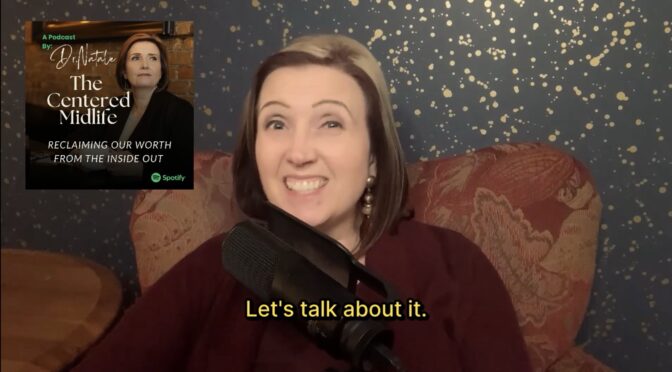
In this heartfelt episode, Dr. Natalie addresses midlife women feeling overwhelmed by the pressure to fix and manage everything alone. She offers insight into how hyper-independence and the fear of abandonment can contribute to burnout and midlife struggles—and most importantly, how self-love can help rewrite these patterns.


Key Topics:

  • The emotional toll of hyper-independence in midlife women
  • The neurochemistry of pursuit and addiction to dopamine hits
  • Childhood experiences shaping adult patterns of fixing and pleasing
  • Recognizing and interrupting the spiral of justification and validation
  • The importance of self-love as an antidote to burnout and scarcity mindset
  • How fear of abandonment fuels hyper-independence
  • Practical steps to love yourself through mistakes and vulnerabilities
  • Moving away from rescuing everyone and focusing on personal peace

Time Stamps

00:00 – Addressing hyper-independent women in midlife

02:09 – The neurochemical roots of pursuit and addiction to dopamine

03:34 – How the chase reinforces the cycle of burnout

04:33 – Personal stories of controlling or fixing others

05:58 – Childhood patterns influencing adult need for approval

06:53 – Recognizing the spiral of justifying and validating

08:22 – The pain of not being liked or validated

09:04 – The risks of over-investment in work and relationships

10:30 – How derailments in pursuit reveal deeper patterns

11:56 – The spiral of self-justification in times of stress

13:20 – The link between childhood chaos and adult control issues

14:19 – Self-love as the key to breaking free from cycles

16:41 – The importance of loving yourself despite mistakes

19:34 – Understanding the fear of rejection and scarcity mindset

20:03 – Letting go of blame and the need for approval

21:01 – Managing relationships without spiraling into chaos

22:24 – Embracing age and experience for self-compassion

23:21 – The power of loving your story, including dysfunction

24:19 – Sharing this message with other midlife women

25:17 – Letting go of the cycle of justification and abandonment fears

26:15 – Finding peace and building inner self-worth

Resources and Links

Connect with Dr. Natalie:

Website https://LearnToLoveYourStory.com⁠⁠
Facebook facebook.com/learntoloveyourstory
Instagram instagram.com/dr.nataliemarr
Linked In linkedin.com/in/natalie-m-marr-psy-d-lp-6a9298147
Tik Tok tiktok.com/@doc.natalie

DISCLAIMER:

The content in this podcast and video is not a replacement for therapy and is not clinical, medical, or mental health treatment. Dr. Natalie Marr is a Licensed Psychologist in the state of Minnesota. Her work with ⁠⁠(⁠LearnToLoveYourStory.com⁠⁠⁠⁠)⁠, ⁠(⁠⁠⁠⁠NatalieMarrCounseling.com⁠⁠⁠),⁠ and all affiliate social media entities is educational and coaching based ONLY. She IS NOT offering therapeutic services of any kind on these mediums.

If you or someone you know is having a mental health crisis or having thoughts of suicide, please use the following crisis resources (this is not an exhaustive list of available resources):

National Suicide Prevention Lifeline: ⁠⁠⁠⁠⁠⁠⁠https://suicidepreventionlifeline.org⁠/⁠⁠⁠⁠ or CALL 988

Crisis Text Line: ⁠⁠⁠⁠⁠⁠⁠https://www.crisistextline.org/ or⁠⁠⁠⁠ ⁠⁠⁠Text HOME to 741741

This is About All of Us – Part 3

“Be one who nurtures and who builds.  Be one who has an understanding and a forgiving heart, who looks for the best in people.  Leave people better than you found them.  If we could look in to each other’s hearts and understand the unique challenges each of us faces, I think we would treat each other much more gently.”      Marvin J. Ashton

I hope you have been finding this series stimulating.  I hope it has stretched you a little in how you are thinking about the things happening in social media these days.  Change is hard, and any “movement” is asking us to bring about change.  We do not know what the outcome of that change will be and this uncertainty is one of the very reasons change is so hard on us.  Last week we talked about how when negative emotional content is as pervasive as we are seeing it in all forms of media right now, we are absorbing this negativity.  And absorbed negativity will do one of two things, it will eat at us or it will eat at others.

So, Doc, what are we supposed to do about that?  Its not like we can stop people from being jerks online.  True.  We cannot control others’ behaviors, only our own.  Yet we hold some of the most powerful tools in our own behavior.  Ok Doc…what powerful tools are those?  Kindness and compassion.  These two tools can help to redirect the energy of negativity into something more constructive.  I want to be sure that we are all on the same page about what that means however.

Kindness is a means by which we deliver our communication with one another and compassion is the means by which we receive it.  We cannot control the actual content of communications always, but we can always control the way we give and receive it.

Sometimes it is easier to describe what these definitions are not, rather than what they are.  Kindness for instance does not mean just being nice.  It does not mean that we are looking to say things in a way that others will be pleased by what they hear.  Instead it is more about showing one’s intention as a bridge of love, while we may possibly be delivering a very difficult message.  I have sat with many people in my office, talking about very difficult things, and have had occasion where the most therapeutic response I can give them is to reflect their own responsibility in their suffering.  This is not an easy message to hear.  No one wants to know that they had any part in what is hurting them, and most of us want to rise up against this and defend ourselves.  There is always a way to deliver this message with kindness. To be on one another’s side in an effort to want to change what is being talked about, while simultaneously communicating a difficult message that would seem opposite to what one another wants to hear.

Compassion is another means for us to meet one another where we are at, when on the surface of the issue there seems to be conflict in our meanings. Compassion is not feeling sorry for someone (sympathy).  It is not knowing better than someone else and having the foresight to see their errors.  Compassion is feeling with somebody (empathy).   In the faith tradition I was raised in, we say, “There if by the grace of God go I.”  This is a reminder that I could be in the very position another is in and I should always receive information with this in mind.  Showing understanding that we too could feel the way that another is feeling and want to say the things that they are saying, takes pause.  It takes patience.  It takes courage.  And most importantly it makes us vulnerable.  Vulnerability of putting ourselves in another’s shoes is difficult, yet it is also truly the only path to understanding and demonstrates great strength.

So, while we are not in control of the content we are seeing in the media and this content is likely to stir a myriad of thoughts and feelings, we are in control of how we give our messages to one another and how we interpret the messages of others.  And when we start to listen and speak with this kind and compassionate approach, we will begin to transform the message without ever changing the content.  We will start helping ourselves know that this is about all of us.  That acting in kind and having compassion for all perspectives will open us up to the knowledge that we help all our cause when we start thinking of it as ours, not theirs versus ours.

My challenge to you my friends…take that pause before you respond.  Think from a stance of compassion.  Say your words with kindness.  Know that the message you are sending is not only in the words but in the manner in which those words are delivered and received.

Be well my friends.