In this heartfelt episode, Dr. Natalie addresses midlife women feeling overwhelmed by the pressure to fix and manage everything alone. She offers insight into how hyper-independence and the fear of abandonment can contribute to burnout and midlife struggles—and most importantly, how self-love can help rewrite these patterns.
Key Topics:
The emotional toll of hyper-independence in midlife women
The neurochemistry of pursuit and addiction to dopamine hits
Childhood experiences shaping adult patterns of fixing and pleasing
Recognizing and interrupting the spiral of justification and validation
The importance of self-love as an antidote to burnout and scarcity mindset
How fear of abandonment fuels hyper-independence
Practical steps to love yourself through mistakes and vulnerabilities
Moving away from rescuing everyone and focusing on personal peace
Time Stamps
00:00 – Addressing hyper-independent women in midlife
02:09 – The neurochemical roots of pursuit and addiction to dopamine
03:34 – How the chase reinforces the cycle of burnout
04:33 – Personal stories of controlling or fixing others
05:58 – Childhood patterns influencing adult need for approval
06:53 – Recognizing the spiral of justifying and validating
08:22 – The pain of not being liked or validated
09:04 – The risks of over-investment in work and relationships
10:30 – How derailments in pursuit reveal deeper patterns
11:56 – The spiral of self-justification in times of stress
13:20 – The link between childhood chaos and adult control issues
14:19 – Self-love as the key to breaking free from cycles
16:41 – The importance of loving yourself despite mistakes
19:34 – Understanding the fear of rejection and scarcity mindset
20:03 – Letting go of blame and the need for approval
21:01 – Managing relationships without spiraling into chaos
22:24 – Embracing age and experience for self-compassion
23:21 – The power of loving your story, including dysfunction
24:19 – Sharing this message with other midlife women
25:17 – Letting go of the cycle of justification and abandonment fears
26:15 – Finding peace and building inner self-worth
The content in this podcast and video is not a replacement for therapy and is not clinical, medical, or mental health treatment. Dr. Natalie Marr is a Licensed Psychologist in the state of Minnesota. Her work with (LearnToLoveYourStory.com), (NatalieMarrCounseling.com), and all affiliate social media entities is educational and coaching based ONLY. She IS NOT offering therapeutic services of any kind on these mediums.
If you or someone you know is having a mental health crisis or having thoughts of suicide, please use the following crisis resources (this is not an exhaustive list of available resources):
Summary In this episode, Dr. Natalie explores the concept of ‘The Great Unlearning,’ a transformative journey that challenges the societal belief that doing everything right leads to a fulfilling life. She reflects on her personal experiences, particularly during midlife, where she realized that striving for perfection and external validation often leads to burnout and disillusionment. Dr. Natalie emphasizes the importance of self-worth and the need to reclaim it from within, rather than through external achievements or approval. Through poignant anecdotes, she illustrates how the pressure to conform to societal expectations can lead to a double life and emotional turmoil, ultimately advocating for a shift towards self-love and acceptance.
Dr. Natalie introduces the metaphor of the tugboat versus the lighthouse to illustrate the difference between exhausting oneself in the pursuit of perfection and standing firm in one’s self-worth. She encourages listeners to reflect on their own lives, identifying where they may be sacrificing their well-being in the name of doing everything right. The episode serves as a powerful reminder that true fulfillment comes from within, and that midlife can be an opportunity for profound personal growth and self-discovery.
Keywords: midlife, self-worth, personal growth, self-love, great unlearning, emotional well-being, tugboat lighthouse metaphor, reclaiming self-worth, Dr. Natalie
Takeaways: The version of you that you’re most proud of may be blocking your actual life. Midlife can be an invitation to examine the mess of our lives and love it as it is. Reclaiming self-worth from the inside out is essential for true fulfillment.
Sound bites: “What if I told you that the version of you that you’re most proud of… is in the way of your actual life?” “Today we’re gonna talk about the great unlearning.” “You do not need to fix yourself. You just need to find yourself.”
Chapters: 00:00 Introduction to The Great Unlearning 03:49 A Holiday Dinner Reflection 10:20 The Tugboat vs. The Lighthouse 18:10 The Power of Self-Love 23:39 Reflecting on Your Journey JOIN the https://LearnToLoveYourStory.com Mailing List! Join my newsletter and receive my FREE video and workbook, “Freeing Yourself: A Guide for Letting Go of Other People’s Opinions”
SIGN UP on the website at https://dashboard.mailerlite.com/forms/762561/109840834025752017/share DISCLAIMER: The content in this podcast and video is not a replacement for therapy and is not clinical, medical, or mental health treatment. Dr. Natalie Marr is a Licensed Psychologist in the state of Minnesota. Her work with (https://LearnToLoveYourStory.com), (https://NatalieMarrCounseling.com), and all affiliate social media entities is educational and coaching based ONLY. She IS NOT offering therapeutic services of any kind on these mediums. If you or someone you know is having a mental health crisis or having thoughts of suicide, please use the following crisis resources (this is not an exhaustive list of available resources): National Suicide Prevention Lifeline: https://suicidepreventionlifeline.org/ CALL 988Crisis Text Line: https://www.crisistextline.org/ Text HOME to 741741
In this episode of Midlife Crisis to a Centered Life Thriving, we talk about how many people in midlife feel stuck, because they lack a sense of peace in their lives. In their search for happiness, fulfillment, and/or purpose, they are feeling tired and overwhelmed. This lack of peace is often caused by living a fragmented life, where different aspects of themselves are compartmentalized.
Women, in particular, struggle with perfectionism and selflessness, neglecting their own needs. To find peace, it is important to embrace all aspects of oneself, including the mistakes and imperfections. By accepting and loving oneself, and living authentically, one can find a centered life and experience true peace.
Takeaways:
Many people in midlife feel stuck and lack peace in their lives.
Living a fragmented life, where different aspects of oneself are compartmentalized, contributes to this lack of peace.
Women, in particular, struggle with perfectionism and selflessness, neglecting their own needs.
To find peace, it is important to embrace all aspects of oneself, including the mistakes and imperfections.
By accepting and loving oneself, and living authentically, one can find a centered life and experience true peace.
Do any of these sound like you?
Feel a sense of lack, despite success in life or having done everything “right”
Struggle to articulate how you feel to others
Experience guilt about how you’re feeling
Have lost your way
Are struggling to overcome turmoil in your life
Have become resigned to accepting a life you don’t love
Many of us are suffering like this — daily life has become an ordeal, and we don’t know where or how to find help.
Dr. Natalie’s Online Courses and Coaching CAN HELP. Click below and get started.
You don’t want to miss a thing we are doing here at LearnToLoveYourStory.com. From our weekly podcasts to our library of blogs and videos that can help you step into a more centered life.
Allow Dr. Natalie to guide you on this empowering adventure to break free, rediscover your passion, and create the life you’ve always envisioned for yourself. Your journey to empowerment starts here. Join our Mailing List today!
Need more clarity on your midlife journey? Sign up for a complimentary call with Dr. Natalie to explore if her transformative coaching program aligns with your aspirations.
Get personalized answers to your questions and discover if Dr. Natalie can help you untangle where you life is now and design the life you want to be living.
Don’t miss the opportunity to embark on a life-changing experience – schedule your complimentary call today and take the first step toward designing the life you deserve!
Please press the “START” button below to answer a few questions and schedule your consultation:
Keywords: Keywords: midlife, peace, happiness, fulfillment, purpose, stuck, overwhelmed, fragmented life, compartmentalization, perfectionism, selflessness, self-care, authenticity, Dr. Natalie, Midlife Crisis to a Centered Life Thriving, podcast for women, podcast for midlife
Disclaimer
The content in this podcast and video is not a replacement for therapy and is not clinical, medical, or mental health treatment. Dr. Natalie Marr is a Licensed Psychologist in the state of Minnesota. Her work with LearnToLoveYourStory.com and all affiliate social media entities is educational and coaching based ONLY. She IS NOT offering therapeutic services of any kind on these mediums.
If you or someone you know is having a mental health crisis or having thoughts of suicide, please use the following crisis resources (this is not an exhaustive list of available resources):
Words can be very powerful. They create narratives for us. They tell us a story about what we are seeing and experiencing in our lives. And, depending on the habits we have gotten into with our words, these words may even morph into a pattern for how we see the world.
What am I talking about? Let me give you an example. I must spill something on a white shirt literally every time I wear one. I am sure there are spills on some of my other colored clothing too, but like clockwork there seems to be a coffee stain or something else colorful on every white piece of clothing I own. So, let’s say this happens and I say, “Natalie, you’re such an clutz! Why can’t you wear white once and not spill on yourself?” Seems like a normal response to this right? Well, let’s compare that to, “Oh my goodness Natalie. Spilling seems like spilling on your white clothes is just your go-to move.” followed by a laugh. What I am getting at is how in the first comment I am devaluing myself as a person because of my behavior and in the second comment I am just making fun of my behavior. It’s a subtle difference in wording that makes a major difference in how we think and feel about ourselves.
I can’t tell you the number of times I have sat across from a client who is struggling with feelings of shame and low self-worth. It’s almost epidemic in our American culture, where we are marketed at from birth to death. And the underlying message from this is that the way we are isn’t good enough as is, so “Buy this product and you’ll be better!!!”. When this culture mixes in with saying things to ourselves and others like, “I am such a clutz!” instead of “Spilling was just an accident”, we alienate ourselves more and more. Self-talk that devalues the person can increase feelings of shame.
So, why do we do this? Possibly because we were taught to. Or, because culture is so prone to use these concepts in marketing. Or even because once it is a habit in our thinking, we start to do it as second nature. I mean think about it, my comment to myself that I was an Clutz for spilling on myself is not all that uncommon, is it? We say things like it all the time. Words hold power. They define things and they narrowly begin to categorize things. So if I call myself names like that enough, it isn’t hard for me to start truly believing this. And this can lead to feeling uncomfortable or awkward when people compliment me, because those compliments aren’t in alignment with what I believe about myself.
I would challenge you this week to take a look at how you talk to yourself, to your friends, and to your family. You might even look at how you talk to others on social media. What phrases do you use? What message do they imply? Is that what you intended to say? I want you to start to notice the words and phrases that are your go-to’s and then think about what narrative they are creating for you about yourself and your world. Our stories are intricately a part of who we are, whether we are calling out the story and looking at it or not. Words are how we make up these stories and word choice is a very powerful thing. Just notice this week where the power is in your words. No need to change things (at least not yet). The first step in anything you want to address, much less change, is to recognize that it is there.
Don’t know if the Learn To Love Your Story could help you. Then take this quiz and see which Online Courses would best help you with your personal growth and development.
What Course Is Right For You?
So many of us get stuck at some point during our lives. We know that we are not fully happy, yet we don't really know what's missing. We just know that we thought it would feel better than this by now. So what gives?
Dr. Natalie's online courses are designed to help you build the skills you need not only to find out what seems to be missing in your life and keeping you stuck; her courses will help you liberate yourself from your past and starting designing the LIFE YOU HAVE ALWAYS WANTED.
Take this quiz and receive an individualized recommendation from Dr. Natalie as to what course would be best for you and why these courses are specially designed to help you with what you need.
Question
Your answer:
Answer
You got {{SCORE_CORRECT}} out of {{SCORE_TOTAL}}
Your Answers
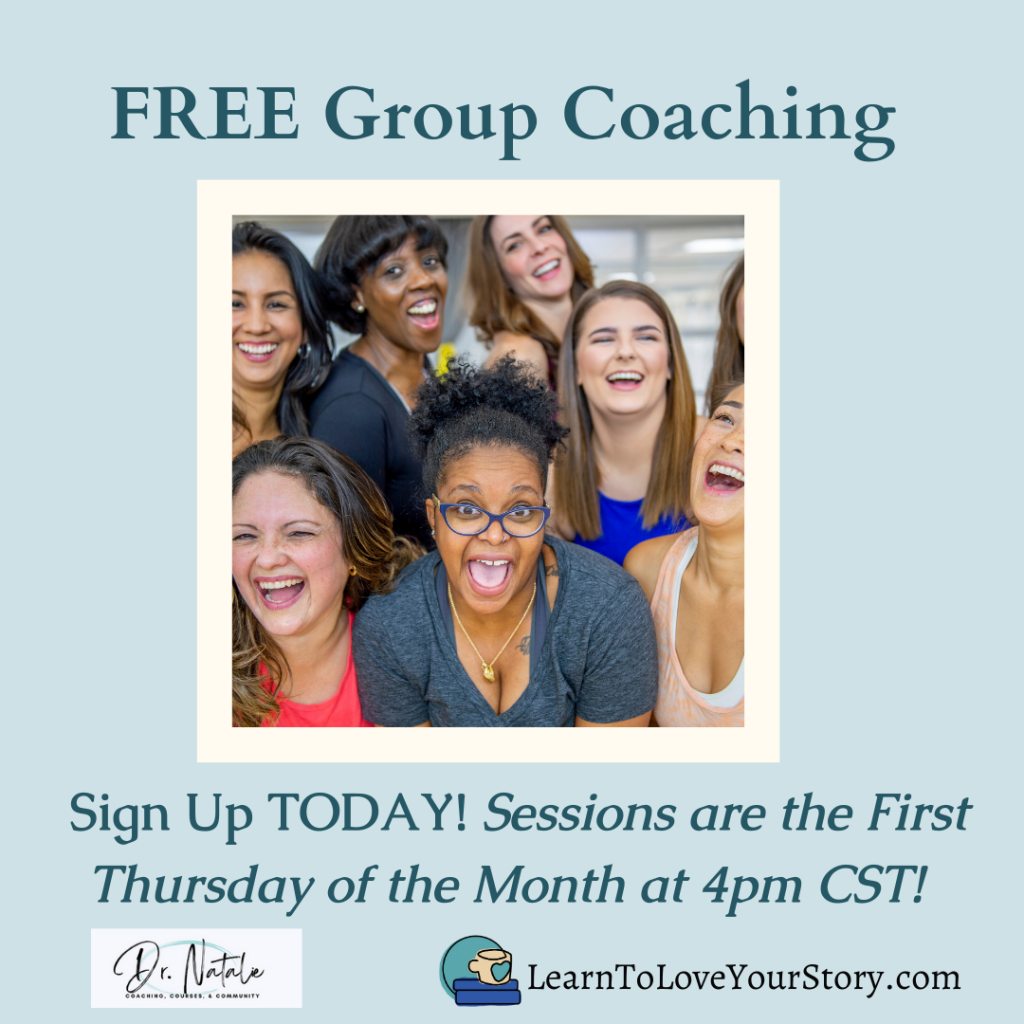
FREE Group Coaching For a Year – Join ANYTIME!
Join us monthly as we work together to help you design the life you have always wanted for yourself. No gimmicks! Just results! Dr. Natalie has nearly two decades of experience as a Clinical Psychologist and she is ready to help women in midlife break the chains of living in constant survival mode.
Please be sure to sign up. Even if you can’t join every month, you will also have access to online courses, workbooks, guided meditations, and get the video highlights sent out after each months group coaching event. It is well worth it!!! Make 2023 your year!!!
Are you somebody who tries to control everything? I don’t know about you, but this was one of my favorite ways to try and solve all of my problems for most of my life. Perfectionism, overwhelm, and continual worry were constant companions of mine. I thought if I could just control the situation then my life would get better. And I kept waiting and waiting and waiting for my life to get better. I was doing all of the right things, I was being perfect as much of the time as I possibly could handle, I was not accepting my mistakes lightly and was very hard on myself to correct them. Yet life still felt…well shitty.
This would culminate during major life transitions. For instance after my first divorce and becoming a single parent to an infant son I was looking at myself in the mirror thinking, “but I did everything right?” Or after I buried both my parents and was left with the aftermath, I would think to myself “Why is this so hard? I knew that they were dying? I went to counseling about this? Why am I still feeling so awful?” But after my most recent iteration of this, a second divorce and financial upheaval, I didn’t even bother asking myself those questions. I just plummeted into the existential crisis of why in the hell is life so hard? Why when I do all the things right, does it not matter anyway?
Have you found yourself in one of these places? If you have you’re in good company. There are a lot of us out here who know that life does not go as planned. Yet we still cling to our desire to control our lives as our only antidote to this. Where did we get that idea? Where did we learn that if we did everything perfect then life would be OK? That was where my curiosity decided to fix itself after my last life upheaval. I couldn’t figure it out at first. Where I had gotten the idea that controlling my life was the answer? Where had we all gotten it?
And what is my favorite part about struggling with this idea of control? I’m a Clinical Psychologist of two decades. It’s not like I don’t have a lot of knowledge in this area, I just had a case of the “I know betters“ like nobody’s business. The emotional side of my brain was not letting the rational side of my brain act for me, so I would go back to my constant companion of trying to control my life over and over. This time though…I was determined to get to the bottom of this. Why control? Why doesn’t it work? Why do we think control should work? And what do we do instead, since control doesn’t work? So I started to investigate. I started to think about why is it that control really doesn’t work? Why is it that being rigid doesn’t seem to answer all our problem?
Our own bodies are a super power for managing the unpredictable. Literally wired to be able to take on whatever comes their way. Does your stomach know what you’re gonna be eating today? Do your lungs know what the quality of the air will be today? Does your body’s immune system know if it’s going to take on a virus and avoid a cold or flu today? No. The plain and simple answer is no. Our body doesn’t know what’s coming its way and yet never complains about it’s job of taking on whatever that is. So if my DNA created that biology for my body, why am I not using this adaptation superpower in other areas my life?
The answer to that question is an interesting one. Because we have been programmed and conditioned that being perfectionistic is more important. We bypassed some of the strategies that would allow our human psyche to pivot out of life challenges, like our body pivots out of new stimuli each and every day. So how do we tap into this adaptive skill that is in our DNA? And why in the heck weren’t we taught this in the first place?
How can we tap into this skill I can answer in five neat steps for you. Why weren’t we taught this in the first place, is a much bigger question. So let’s start with the five steps you need to take to be able to tap into the adaptation superpower you are already hardwired to do. To be agile and take on all life throws at you, without knowing what’s coming your way and to do so with grace, kindness, and understanding.
Step One – Stop looking for validation outside of yourself.
This one’s tough people. This is not what we were taught to believe. Right from the start our validation came from outside of us. Our parents encouraged us when we were learning things. Our teachers graded us when we were in school. Our peers chastised us if we went outside what was “cool“. And into our adulthood our partners, coworkers and communities were telling us if we were doing our lives well or not. I want you to think for a minute how ridiculous that sounds. How does SOMEBODY ELSE know if I’m doing MY LIFE well? How do they even know? They don’t. That’s the truth. They know only what I let them see and they have no idea what’s going on inside me…what I am keeping hidden from them. So why do I care what they think so much? Easy. You were taught to care what they think. You were taught that your opinion of yourself was very insignificant and that the place that you look to know if you’re doing life well is outside yourself.
This is step one. Flip that on its head. Your opinion is really the only one of significance with regard to how you’re doing in your life. There are lots of ways to tap into that. For starters, knowing what you’re feeling in your body at any given time. Our bodies are great instruments for telling us if something is OK or not. We feel energized, content and sometimes even joyous when we’re in alignment with what we should be doing in life. When you’ve found your purpose and you’re following through on that purpose, you know it in your bones. Yet, when you start to feel super crummy (a.k.a. I feel like my life is shitty even though I’m doing all the right things) then you know something is amiss. It does not matter if everybody is telling you that you’re doing life well. If you feel in your body life is shitty…then life is shitty and you need to shift something.
Listen, I know that we love our whips. I know that our internal self critics have all kinds of things to say to us about how we’re doing things the wrong way. I know how internal self critics love to jump on us when we actually have done something wrong. I know that this internal self critic is coming from a good place, trying to correct our behavior and pull us into the right direction. And, I know that almost never works out that way. We do not learn out of fear. We survive out of fear. We do not live, do not learn, and do not like our lives when we come from fear. So please, for the love of all that is holy, put away the whip.
This is actually tied to step one. We were taught that our opinions of ourselves were very insignificant while other peoples opinions of us were very important. Guess where that self critic came from? It wasn’t out of yourself. I know you think it was, and our self critics have our voices, so its easy to believe its a part of us. In actuality, our self critics are an internalized version of that external validation that we’re seeking. Your internal critic is going to tell you what everybody on the outside would tell you. This is not a reliable source. Unless, of course, you use your internal critic as an example of what not to do. Then do what is opposite to what your internal self critic is focusing on. Using it this way can be useful. I call that a rumble strip.
Step Three – Be kind and understanding as you’re growing
This goes with number two and number one, but it does deserve its own step. Kindness and understanding doesn’t mean permission to be a lump on a log. It doesn’t mean that I am saying to you just roll and wallow in your own self-pity. What it means is don’t get out of whip and expect that you’re going to respond well to that. Do come along side the part of you that has made a mistake and created a mess in your life, hold that part of you very tightly, and whisper into that part’s ear “It’s going to be OK! I’m here now. I get how we got here and I will stay with you while we figure out how to get out of here.”
That is what we need. Not a whip. We need to know that someone has our back and that someone needs to be our self. Not some hippie dippy mumbo-jumbo that a psychologist is throwing at you, a legitimate need to feel like we have our own back. Because honestly, if we don’t then who does?
Life is not easy and it takes a lot of energy so if you’re not replenishing yourself you’re going to run out. It’s pretty simple math people. And I hate math. But it is pretty simple. If you aren’t caring for yourself above and over all things in your life, nothing you ever do in your life will be at its full potential. End of sentence. That is the truth. I know we don’t wanna hear that, and I definitely know it’s not in alignment with our whips, our internal self critics, or the programming and conditioning that we’ve received that putting ourselves first is selfish. Throw away that rhetoric right now! Get a self-care plan in place as soon as possible. And radically approach your self-care as a necessary need that you have to meet every single day. Like eating. Using the bathroom. Breathing. I promise you this is pivotal. You really can’t do all the other stops if you’re not doing this one.
This one sounds pretty funny but it is so true. Humans are very predictable. We like a good game. Well…we like to WIN a good game. We don’t like to lose and so it is good to play off of this innate inner joy. Make a game. Make a game of everything you do. Challenge yourself. Allow yourself to morph the rules to your advantage. The ultimate goal is YOUR JOY. So even things like your work or the most mundane parts of your life that have to get done, can be transformed into a game. And when you do this, they become so much easier. You’re the only player. You’re the rule maker. And this allows a flexibility like nobody’s business.
Now, on a neurological basis what I’m really asking you to do is to go outside your box all the time. If you want to land in the place where you’ve been before keep doing what you’re doing. If you want to do all the right things only to arrive at a place where life feels shitty, then by all means do what you know to do and what you have been doing all this time. It is a tried and true map to that destination. However, if you want life to be different you’re going to have to do things differently.
And the worst part of that, is how uncomfortable it feels. Like excruciatingly uncomfortable. Yet if you make a game out of it, it engages a part of your brain that is made for creativity. Our right brain. Not language-based. Sometimes not all that logical. Our right brain puts together pieces that don’t go together usually. But it allows us to work outside our box, which will take us to a new destination. Now if you get to the destination and don’t like it, change the rules again. Make it a game again. Keep working at winning in your life. It’s fun. You’ll enjoy it. And honestly. That’s what life should be.
So, no more control…lets do these five steps and find ourselves in a much better place.
Don’t know if the Learn To Love Your Story could help you. Then take this quiz and see which Online Courses would best help you with your personal growth and development.
What Course Is Right For You?
So many of us get stuck at some point during our lives. We know that we are not fully happy, yet we don't really know what's missing. We just know that we thought it would feel better than this by now. So what gives?
Dr. Natalie's online courses are designed to help you build the skills you need not only to find out what seems to be missing in your life and keeping you stuck; her courses will help you liberate yourself from your past and starting designing the LIFE YOU HAVE ALWAYS WANTED.
Take this quiz and receive an individualized recommendation from Dr. Natalie as to what course would be best for you and why these courses are specially designed to help you with what you need.
Question
Your answer:
Answer
You got {{SCORE_CORRECT}} out of {{SCORE_TOTAL}}
Your Answers
FREE Group Coaching For a Year – Join ANYTIME!
Join us monthly as we work together to help you design the life you have always wanted for yourself. No gimmicks! Just results! Dr. Natalie has nearly two decades of experience as a Clinical Psychologist and she is ready to help women in midlife break the chains of living in constant survival mode.
Please be sure to sign up. Even if you can’t join every month, you will also have access to online courses, workbooks, guided meditations, and get the video highlights sent out after each months group coaching event. It is well worth it!!! Make 2023 your year!!!
Did you know that you can book a call and talk to Dr. Natalie directly! She would love to help you personally and answer any questions you have about her offerings. Sign up for her complimentary DEEP DIVE CALL now. No charge. No obligation. Just 30 minutes 1:1 with Dr. Natalie herself.
It’s the fall and most of us in America have been conditioned to think of fall as football season. Both college and professional. And how many times have you heard or seen the idea of “a house divided“. This is a tongue and cheek way of talking about living in the same household and favoring different teams that are arch rivals. It’s fun and we see lots of memes about it. It can get dicey, but for the most part it is all fun.
But what if the division is inside yourself? What if there are parts of yourself that you desire to disavow? Do you have these aspects of yourself that you want to reject? Here is my question for you… How do you know that these are parts of yourself that should be rejected? Where did you learn that these aspects of yourself are not worthy? Could you unlearn this?
More than likely where you learned not to love this aspect of yourself was in the rules of social conditioning. Social conditioning is a powerful pull. It teaches us what we should and should not be. And I don’t mean to give this a totally bad rap. There are values to social conditioning, including that this keeps us on the straight and narrow, away from making bad choices that could be harmful to ourselves or others. This has value in some places in our life. However, it’s a runaway train. Social conditioning starts to make opinions about subtleties and aspects of our self that we cannot change. When this starts to happen, we start to be a self, divided.
We take the war from the outside and turn it inside. Our internal conflict with parts of ourselves that we do not like about us, creates a discomfort that we seek to numb or deny. One way or the other we are pushing against our own self. And when we are in conflict with our self, we start to be in conflict with our outer world as well.
Warning this is a part where you will hear some therapist speak that likely will irritate you. It’s the section of the blog where I say things that you know to be true, but hate when I’m right.
If you are noticing more irritability in your life or that you’re trying to numb away with over eating, drinking, overworking, or whatever your favorite numbing agent is, then it is likely that there is division within yourself. What you’re noticing on the outside is an effort to make this division either go away or to escape from this discomfort. Yet, the division really isn’t on the outside, it’s on the inside. What about this thing you’re pushing away from, this irritation, this aspect in your outer world that you do not like, has a parallel on the inside of yourself? Think about it.
Let me give you an example. Let’s say that you are in line at the grocery store and someone asks you if they can go ahead of you because they only have a few items and you have a full cart. Normally this is something you would offer to another person, however you hadn’t noticed this individual standing behind you. Now you’re irritated that they have the audacity to ask. Yet, you let them go ahead of you anyway. Now you’re irritated with this person. Irritated by their arrogance in asking, or at least that’s what you tell yourself.
You know what I’m going to say next. You aren’t irritated with this person at all. You are irritated with yourself. Maybe you’re irritated that you allow people to walk all over you. Maybe you’re irritated that this person has the capacity to ask for what they need, and you do not. Maybe you’re just irritated that you didn’t notice that they were there and weren’t able to offer before you were asked. Whatever you’re irritated with, you can bet that it’s a part of yourself that you don’t like. It’s an aspect of you that you’ve noticed in the past and you try to push away. It may even be an aspect of yourself that you don’t think is changeable. I assure you that is not the case. Anything inside of you is changeable. But maybe it doesn’t need changing. And that is where true irritation comes to play.
Why wouldn’t we change some thing about ourselves that’s irritating? I’ll tell you why…because it’s not a part of us that needs changing. It’s a part of us that needs acceptance. It’s a part of us that needs loving. It’s a part of us. And therefore it should not be something that we reject but some thing that we pull close. But what if these aspects of our self are in opposition to other aspects of our self? How do we accept those? This is the paradox. That two seemingly opposite things can be true at the same time, even when they are opposite things about ourselves. These can be excepted. These can coexist. And the way we facilitate peace about this is through loving all aspects of our self…the good, the not good, and everything in between.
And know, I have a monthly Master Class for FREE, in an intimate coffee and conversation setting. This is a great place to get some FREE Group Coaching from me, helping you be the best version of yourself all the time. Please be sure to sign up. Even if you can’t join every month, you will be part of the mailing list to hear about the topics and get the video highlights I send out afterwards, so it is well worth it.
Or, if you are looking for something a little more in depth, take a look at the Online Courses that I offer to help people with their personal growth and development.
Learn to Love Your Story is so excited to be able to offer this monthly subscription Personal Development Course for you at only $74.95 a month. This is A STEAL!!!
Dr. Marr has put together all of the materials that she would normally use as psycho-education for her clients receiving therapy and put it all into one handy place.
Course like this are usually hundreds of dollars! Because this is Dr. Marr’s first try at helping others through a platform like this, she has decided to offer it at this low rate. Plus, she really wants others to help themselves right now, during such difficult times in the world!
So don’t miss out! Here is a video on what the course entails. And don’t forget to pre-register here!
I have fond memories of December 24, when my dad would finally get around to going Christmas shopping for his wife and five kids! It was his usual. So was “wrapping” those gifts in the bags that they came in from the store (you were lucky if he remembered to take the receipt out of the bag:).
So, if you find yourself in a similar spot today…rushing to get a gift in last minute…let Learn to Love Your Story help you out. Pre-register your loved on for our course here, and we will send them a free journal (seen in the image below) to use along with the course.
And for those of you who haven’t heard about the Personal Development Course yet, please watch this video to learn more.
So much of the stress that we endure has to do with the way that we manage what is happening to us, and very little to do with what is actually happening.
I want to help you learn how your brain and nervous system work, in order to help you feel more skilled in how you manage yourself in all circumstances.
Check out my video on the Learn to Love Your Story Personal Development Course that is starting January 1, 2021. And pre-register for the course here.
“I am still learning how to go back and re-read my own chapters without feeling like I want to set all of my pages on fire.”
E. V. Rogina
Ever feel like this? Ever think that you wish you could scratch out a part of your past? Ever want to lie (or actually did lie) about something you have done, thought, felt, because you’re afraid if people actually knew who you really are or what you’ve really done, well they wouldn’t want anything to do with someone like that.
Well guess what? You’re not alone. Many of us do this. We are scared of our pasts. Ashamed of them. Haunted by the idea that the choices we presently make are so incongruent with that past, people wouldn’t…dare I say couldn’t believe we have changed.
Yet we have changed. All of us. We cannot stay in the same place. We are always moving. We may carry with us the dead weight of choices we have made, yet it won’t stop us from evolving. We are literally wired to do this. To adapt. To grow. To become better versions of ourselves. To not only survive, but to thrive in this world.
So now you’re asking…”What is that Dr. Marr rambling about now?” Here it is folks: Nothing about our mistakes in the past define who we are in our present. One of my favorite quotes by Maya Angelou is “Do the best you can until you know better. Then when you know better, do better.” Our brains not only compel us to do this, our genetic makeup actually wires us to do this.
So guess what that means? Your mistakes. Those shameful events from your past. Those are as integral a part of your beauty today as are the successes you’ve made. Indeed they are some of your greatest successes. (That’s right, I just said the mistakes you feel ashamed of having done in your past are some of the most beautiful aspects of who you are today!)
So, Dr. Marr is rambling today to tell you…we NEED to love these mistakes as much as we love our successes. We don’t have to love them the same way though. Having a reverence for our failings as much as we have for the goals we’ve met is a matter of how much relevance we allow those lessons to mean in our life. It is not about how much we like them.
So stop thinking compassion means we have to “like” our past. It merely means we hold these lessons in as high a regard as we do things that we easily want to elevate from our pasts.
So go on. Love it. All of it! The bad and the good. The ugly and the beautiful.