Tag Archives: stress management

Caught in the Middle: Supporting Aging Parents While Raising Children

Summary

This episode explores the challenges faced by the sandwich generation—adults caring for aging parents while managing their own families and careers. Dr. Natalie shares insights on emotional, physical, and financial strains, and offers practical strategies for setting boundaries, seeking support, and prioritizing self-care to navigate this demanding phase of life.

Keywords

sandwich generation, midlife, caregiving, self-care, boundaries, emotional health, physical strain, financial stress, family dynamics, personal growth

Key Topics

  • Statistics on adult caregivers and gender differences
  • Emotional and physical toll of caregiving
  • Financial challenges faced by caregivers
  • The shift from transactional to relational caregiving
  • Strategies for setting boundaries and seeking support

Takeaways

  • Prioritize self-care to sustain caregiving capacity
  • Set clear boundaries to protect emotional and physical health
  • Seek support and resources to avoid burnout
  • Reframe caregiving as an act of self-love and modeling for future generations
  • Recognize that saying no is a valid and necessary choice

Sound bites:

  • “You’re not alone in this.”
  • “64% report moderate to high emotional strain.”
  • “Saying no is a valid and necessary choice.”

Chapters

  • 00:00 Understanding the Sandwich Generation
  • 06:22 Financial Strain and Overwork
  • 11:19 Setting Boundaries and Self-Care
  • 16:39 Modeling Healthy Behaviors for Future Generations

Resources & Links to Connect with Dr. Natalie:

Learn to Love Your Story Coaching- ⁠⁠https://learntoloveyourstory.com⁠⁠

Dr. Natalie’s Counseling Practice – ⁠⁠https://nataliemarcounseling.com⁠⁠ If you are in MN, book your free 15-minute consultation with Dr. Natalie.

Facebook:⁠ ⁠⁠⁠https://www.facebook.com/learntoloveyourstory⁠⁠⁠⁠⁠

Instagram:⁠⁠⁠⁠ ⁠https://www.instagram.com/dr.nataliemarr⁠⁠⁠⁠⁠

Linked In:⁠ ⁠⁠⁠⁠https://www.linkedin.com/in/natalie-m-marr/https://www.linkedin.com/in/natalie-m-marr/

⁠⁠⁠⁠Tik Tok:⁠⁠ ⁠⁠⁠https://www.tiktok.com/@doc.nataliehttps://www.tiktok.com/@doc.natalie

DISCLAIMER:

The content in this podcast and video is not a replacement for therapy and is not clinical, medical, or mental health treatment. Dr. Natalie Marr is a Licensed Psychologist in the state of Minnesota. Her work with ⁠⁠(⁠⁠⁠⁠⁠⁠⁠⁠https://LearnToLoveYourStory.com⁠⁠⁠⁠⁠⁠⁠⁠⁠⁠⁠)⁠, ⁠(⁠⁠⁠⁠⁠⁠⁠⁠⁠⁠⁠https://NatalieMarrCounseling.com⁠⁠⁠⁠⁠⁠⁠⁠⁠⁠),⁠ and all affiliate social media entities is educational and coaching based ONLY. She IS NOT offering therapeutic services of any kind on these mediums. If you or someone you know is having a mental health crisis or having thoughts of suicide, please use the following crisis resources (this is not an exhaustive list of available resources):

National Suicide Prevention Lifeline: ⁠⁠⁠⁠⁠⁠⁠⁠⁠⁠⁠⁠⁠⁠https://suicidepreventionlifeline.org⁠/⁠⁠⁠⁠⁠⁠⁠⁠⁠ ⁠⁠or CALL 988

Crisis Text Line:⁠
⁠⁠⁠⁠⁠⁠⁠⁠⁠⁠⁠⁠⁠https://www.crisistextline.org/⁠⁠⁠⁠⁠⁠ ⁠⁠⁠⁠⁠⁠⁠⁠or Text HOME to 741741

The Exhausting Lie that Perfectionism Sold You

Summary:

This episode explores the impact of perfectionism, societal conditioning, and hormonal changes during midlife on women’s mental health. Dr. Natalie shares data, personal insights, and practical advice to help women love themselves and navigate this transformative phase with resilience.

Keywords:

midlife, women, perfectionism, mental health, hormonal changes, self-love, resilience, menopause, societal conditioning

Key topics:

  • Perfectionism and its impact on mental health
  • The connection between hormonal changes and emotional well-being
  • Societal conditioning and self-betrayal in women
  • Practical steps to cultivate self-love and resilience

Sound bites:

  • “Relearn who you are and what you want.”
  • “Deserving love even when you screw up.”
  • “You do not have to be good.”

Chapters:

  • 00:00 The Burden of Perfectionism in Midlife
  • 03:24 Understanding the Mental Health Crisis for Women
  • 11:29 The Impact of Hormonal Changes and Medical Misunderstandings
  • 28:13 Reclaiming Self-Worth and Breaking Free from Perfectionism
  • 36:18 Introduction and Disclaimer
  • 37:55 Crisis Resources and Support

Resources & Links to Connect with Dr. Natalie:

Resources:

DISCLAIMER:

The content in this podcast and video is not a replacement for therapy and is not clinical, medical, or mental health treatment. Dr. Natalie Marr is a Licensed Psychologist in the state of Minnesota. Her work with Learn To Love Your Story coaching ⁠⁠(⁠⁠⁠⁠⁠⁠⁠https://LearnToLoveYourStory.com⁠⁠⁠⁠⁠⁠⁠⁠⁠⁠)⁠ and her private practice ⁠(⁠⁠⁠⁠⁠⁠⁠⁠⁠⁠https://NatalieMarrCounseling.com⁠⁠⁠⁠⁠⁠⁠⁠⁠),⁠ and all affiliate social media entities are educational ONLY. She IS NOT offering therapeutic or coaching services of any kind on these mediums.

If you or someone you know is having a mental health crisis or having thoughts of suicide, please use the following crisis resources (this is not an exhaustive list of available resources):

Understanding Trauma Beyond the Bad Things – A Midlife Lesson

Summary:

Dr. Natalie explores the impact of childhood trauma, emotional health, and resilience in midlife. She emphasizes the importance of showing up for oneself, understanding trauma beyond the obvious, and building internal resources for a centered midlife.

Keywords:

trauma, midlife, emotional health, resilience, childhood experiences, self-worth, connection, coping strategies

Key Topics:

Trauma and childhood experiences
The impact of emotional health in midlife
Strategies for showing up and building resilience

Takeaways:

  • Trauma is not just what happens to us but whether we have resources to manage it.
  • Showing up for yourself daily is crucial for growth in midlife.
  • Connection and empathy are powerful tools for managing emotional distress.
  • Understanding your childhood experiences can inform your midlife health.
  • Self-compassion and small steps are key to navigating midlife challenges.

Sound bites:

“Being an outsider in childhood can be traumatic”
“Trauma impacts hormones and physical health”
“Good days in midlife are moments to cherish”

Chapters:

00:00 Embracing Midlife Challenges
10:30 The Role of Connection in Healing
18:58 Strategies for Navigating Midlife
21:12 Introduction and Disclaimer
22:49 Crisis Resources and Support

Resources:

Resources & Links to Connect with Dr. Natalie:

Website:⁠ ⁠⁠⁠https://LearnToLoveYourStory.com⁠⁠ ⁠⁠⁠⁠

Facebook: ⁠⁠facebook.com/learntoloveyourstory⁠⁠⁠

Instagram:⁠⁠⁠ instagram.com/dr.nataliemarr⁠⁠⁠

Linked In: ⁠⁠⁠linkedin.com/in/natalie-m-marr-psy-d-lp-6a9298147

⁠⁠⁠Tik Tok:⁠ ⁠⁠tiktok.com/@doc.natalie⁠⁠⁠

DISCLAIMER:

The content in this podcast and video is not a replacement for therapy and is not clinical, medical, or mental health treatment. Dr. Natalie Marr is a Licensed Psychologist in the state of Minnesota. Her work with ⁠⁠(⁠⁠⁠⁠⁠⁠https://LearnToLoveYourStory.com⁠⁠⁠⁠⁠⁠⁠⁠⁠)⁠, ⁠(⁠⁠⁠⁠⁠⁠⁠⁠⁠https://NatalieMarrCounseling.com⁠⁠⁠⁠⁠⁠⁠⁠),⁠ and all affiliate social media entities is educational and coaching based ONLY. She IS NOT offering therapeutic services of any kind on these mediums. If you or someone you know is having a mental health crisis or having thoughts of suicide, please use the following crisis resources (this is not an exhaustive list of available resources):

National Suicide Prevention Lifeline: ⁠⁠⁠⁠⁠⁠⁠⁠⁠⁠⁠⁠

https://suicidepreventionlifeline.org⁠/⁠⁠⁠⁠⁠⁠⁠ ⁠⁠

CALL 988

Crisis Text Line: ⁠⁠⁠⁠⁠⁠⁠⁠⁠⁠⁠⁠

https://www.crisistextline.org/⁠⁠⁠⁠ ⁠⁠⁠⁠⁠⁠⁠⁠

Text HOME to 741741

Exhausted? Overwhelmed? Here’s the Solution – Love Yourself First!!!

Sometimes there are just people, times, or situations that really drain us of all we have to give. This is a tell tale sign that our input is not outweighing our output. We wouldn’t expect a car to drive 300 miles on an empty tank of gas, yet we often expect this of ourselves. Lets change that. Here are some things you can do:

1) EXTRA Self-Care This Week:

  • Get your body moving
  • Set boundaries on how much news you watch or social media you scroll through
  • Play games
  • Listen to music that gets your spirit lifted and your body grooving
  • Read a book
  • Dance like no one is watching
  • Do the things that bring you joy on a small scale or a big one
  • Just do them. Do lots of them. And do them over and over.

Emotional Exhaustion in large part comes from our inability to give more without replenishing ourselves first. Read that again and think about it. If you’re afflicted with the social conditioning that tells you your worth comes from how much you give of yourself, then you’ve known this kind of exhaustion. It’s a black hole. You can never give enough of yourself to satisfy this false ideal that once you’ve given enough you will arrive at your ultimate worth. Instead you keep giving until the point of overwhelm, not feeling worthy.

So invert this principle. Seriously. Invert this process of giving to others before yourself on its head. Love yourself first and foremost and watch what happens.

woman covering face with book on bed
Photo by Lina Kivaka on Pexels.com

Which leads me to my second reminder to us for the week:

2) SELFISH is the New SELFLESS

I mean it. We have to throw out these ideas that we have to do things for others at a cost to ourselves. It creates a ledger of sorts. It has yourself in one column and others in another column. You start with a finite amount of you and quickly deplete your emotional energy when you give and give and give and give to others by taking and taking and taking and taking from your column on the ledger. You’re swiftly in debt, but only to yourself. And because you’re putting you last and others first, you remain in debt and keep creating more of it.

So…INVERT this. Instead of giving OF yourself first, give TO yourself first. Always.

  • Give yourself the LOVE you need, so you can love others
  • Give yourself the RESPECT you need, so you may respect others
  • Give yourself the TIME you need, so you have time for others

You see when we are full with what we need FIRST, we can give so much more. When we deplete ourselves by giving more to others than to ourselves, our worth inherently devalues. Yet our culture tells us that our worth is in this depletion of self to be selfless for others. Which honestly means you become yourself less.

I call BS!!! It’s simple math here (and those who know me, know math is not my favorite…so if I am pulling it out then I mean business). If we add to our worthiness by giving to ourselves first, there is more worth to be shared. If we take from our worthiness to give to others before ourselves, then eventually we will be depleted and devalue ourselves in the process.

We will be emotionally exhausted and eventually totally overwhelmed. And we will start to literally be unable to emotionally empathize with others. To see their point of view. To imagine walking a mile in their shoes. When we lose sight of these things the value of our giving diminishes more and more. Not to mention we become more and more awful to each other, the more and more we feel dehumanized ourselves.

If we add to our worthiness by giving to ourselves first, there is more worth to be shared. If we take from our worthiness to give to others before ourselves, then eventually we will be depleted and devalue ourselves in the process.

Natalie M. Marr, Psy.D., LP

So take a minute. I’m serious! Take a few if you need to. Think about how you can do some extra self care this week. Write it down! Yup. On an old fashioned piece of paper. Maybe a post-it. And stick those ideas in all the places you frequent. The bathroom mirror. Near the steering wheel on your car. In your daily planner. On the refrigerator. Be sure to have these ideas readily available and nagging at you this week so you remember to do them. THEN…watch what happens. When you give to yourself first you have more to give.

Need ideas? Listen to my latest podcast

And if you are still looking for help. Download my Free Self-Care Cheat Sheet here:


Don’t know if the Learn To Love Your Story could help you. Then take this quiz and see which Online Courses would best help you with your personal growth and development.

What Course Is Right For You?

So many of us get stuck at some point during our lives.  We know that we are not fully happy, yet we don't really know what's missing.  We just know that we thought it would feel better than this by now. So what gives?

Dr. Natalie's online courses are designed to help you build the skills you need not only to find out what seems to be missing in your life and keeping you stuck; her courses will help you liberate yourself from your past and starting designing the LIFE YOU HAVE ALWAYS WANTED.  

Take this quiz and receive an individualized recommendation from Dr. Natalie as to what course would be best for you and why these courses are specially designed to help you with what you need.

This image has an empty alt attribute; its file name is Copy-of-Aesthetic-Phone-Mockup-Instagram-Post-1080-%C3%97-1920-px-Instagram-Post-Square-6-1024x1024.png
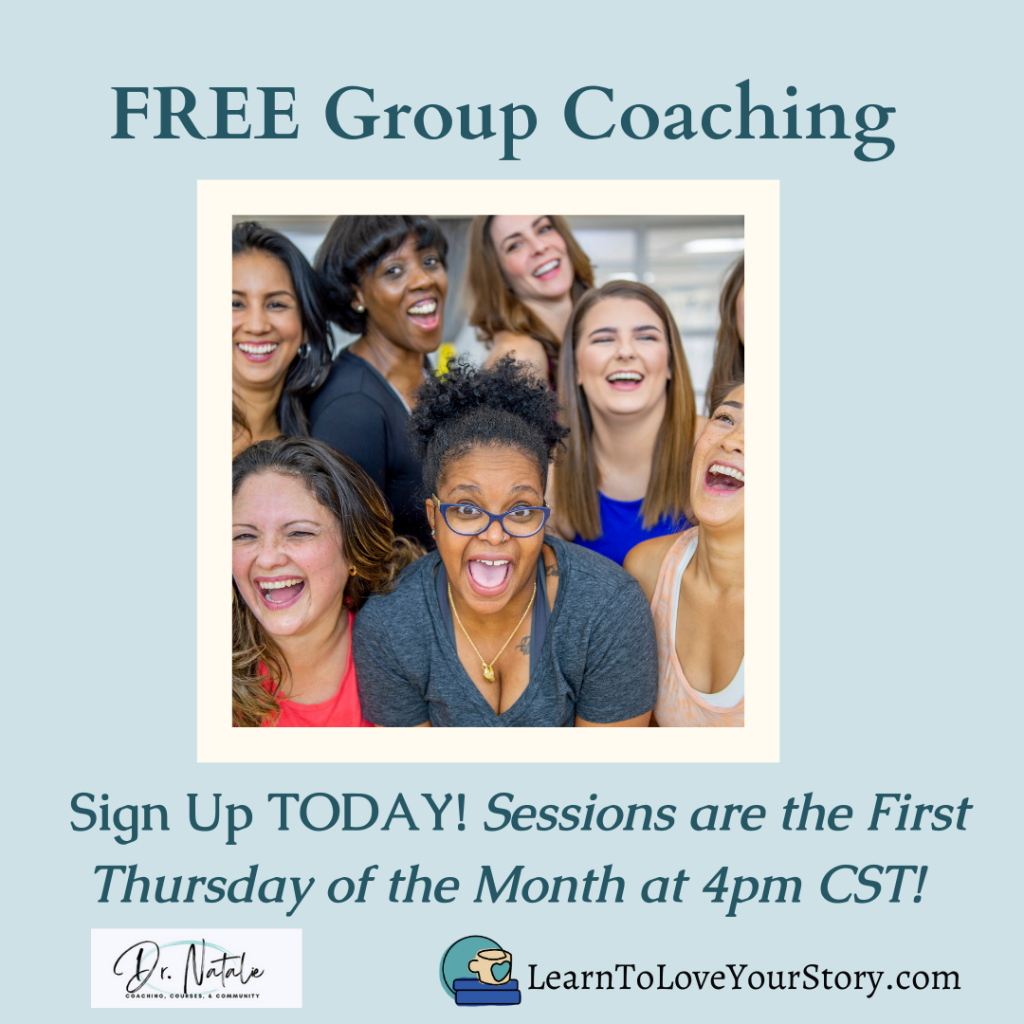
FREE Group Coaching For a Year – Join ANYTIME!

Join us monthly as we work together to help you design the life you have always wanted for yourself. No gimmicks! Just results! Dr. Natalie has nearly two decades of experience as a Clinical Psychologist and she is ready to help women in midlife break the chains of living in constant survival mode.

Please be sure to sign up. Even if you can’t join every month, you will also have access to online courses, workbooks, guided meditations, and get the video highlights sent out after each months group coaching event. It is well worth it!!! Make 2023 your year!!!


How To Work With Dr. Natalie

This image has an empty alt attribute; its file name is Grey-and-Orange-Photography-Quiz-Instagram-Post-Blog-Banner-Facebook-Post-Landscape-720-%C3%97-720-px.png
 

This is All of Us – Part 2

So, here it is.  Part 2.  I know you think that I am going to wax eloquent about #Metoo movement and my opinions on the significance of last week’s events.  But you would be wrong.  Sure, I have opinions on that kind of thing, but “This is about us…all of us.”

So, there are plenty of great conversations and some not so great ones happening about the Dr. Ford/Judge Cavanaugh issue and I will encourage you to go look at those to have more discussion about that issue.  This blog is going to cover a broader issue that is more interesting to me.  What issue is that you ask?  Well my peeps, that would be the mental health of all us and how what we are seeing play out in the media is having a toll on us all.

If you are continuing with me from last week’s blog, you recall that I took us through an exercise of evoking emotion.  It wasn’t a long blog and the visualization was rather simple, and yet, when done right should have evoked some real emotional response from you.  (If you haven’t read that blog, go back and do it…it’s a good one, I promise).  So, think for a minute about how much of an emotional response you had last week after reading the blog and also think about what, if any, affect it had on you the rest of the day.

Why is this important Doc?  And why do you find this interesting?

Well folks, here is why.  We are steeped day to day in stress.  Good stress, bad stress, fun stress, strenuous stress…all around stress.  It comes from our responsibilities to family, friends, coworkers, and honestly to all of us.  A good stress for me is having to get up earlier than I would like to get both myself and my three and half year old ready in the morning.  She is so into brushing her teeth and picking out her clothes and showing me how big she is.  It’s darling, but it is also an extra half hour of an already crunched morning.  I am tired just thinking about it right now, and yet I wouldn’t give this stress up for the world.  A strenuous stress for me is cleaning the house, which I would love to give up if anyone is offering.

When we know our baseline is stress and then are inviting in more emotionally evoking activity into our “down time”, what do you think is going to happen?  You got it…more stress.  And how much stress do you think any one of us can take?  Well that is the really interesting part for me.  Of course, the standard answer to this is “It depends”.  But no lie folks, it REALLY depends.  It depends on how much resiliency you have built up, what your home life is like, where you work or whether you work, how your social life is, your genetic make-up, and on and on and on.

So, the upshot of my point today is, this level of conflict in our life is detrimental and if not well balanced out, it will start to leak out in ways we may not mean or want it to do.  Remember how I asked what you felt like the rest of the day after reading my blog…well, this is what I am talking about.  If you evoke negative emotion it will come out.  If you consume negative emotion it will come in.  And once it comes in, it will make its way out again.  Your resiliency will predict if that is done in a healthy way or in non-healthy and sometimes even abusive way.  And when I say abuse, I am not using that word lightly.  And I am using it in a broad sense.  We “self” abuse through negative self-talk, emotional eating, abuse of drugs and alcohol, among other things.  And we “other” abuse when we cause conflict, yell, say hurtful things, and otherwise cause relational disruptions.  This is real people.  If you have ever seen the movie The Green Mile I would liken it to the green cloud of bug like stuff that the John Coffey character would suck out of one person and then spew into another.  When that stuff was sucked in it made him sick until it was released.  And when it was released it made the receiver sick as well, unless of course it was released into the air and disbursed without harming anyone. Every time you read, watch, or otherwise engage in the “Us vs Them” conflicts that you are seeing used in all media platforms, you are sucking in some of that bad stuff.  That negative emotion has been absorbed into you and will have an impact on you or others if not disbursed in a constructive way.

Remember this as you are engaging with this emotionally laden material.  Even when the topic is a good one to be aired, the emotional toll it takes on all of us is very real.  Be mindful of this.  Take care of yourselves with it.  And do not underestimate how much of a disruption it can and will cause you if you aren’t taking it seriously.  This is the landscape in which the stress you already have in your life will be occurring.  How much of it do you want to let in?  Be intentional.  This is an added emotional need you will have to address.  Be sure it is something you are choosing and not something you are inadvertently exposing yourself to because the average American adult looks at their phone somewhere in the neighborhood of 50 times a day depending on age.

What is happening in the media is affecting all of us, whether we directly engage or not.  Because as long as some of us are engaging, all of us are in play to be affected by the negativity that can result from these conflictual interactions.  Now, here is the good news…(It’s about time, Doc because this has been a Debbie Downer blog today.)

…the positive energy of emotion works the same way.  It will spread with the same amount of fervor and I would contend is the only real solution to dispersing the negativity in a healthy way.  How you ask?  Well that will be part 3 of this series.

Did it again, didn’t I?  Looped you in for another blog.  Come on, at least you may have learned something.  And if not learned something you at least want to go watch a really good movie, The Green Mile.

‘Til next week…be well my friends.